
The problem: 20–30% of compliant supply slips out in the harvest window
The plot followed the protocol. The produce is on-spec. You spent a full season earning that supply. Then in a 10–15 day window at harvest, 20–30% of it walks off to a competitor buyer or a local trader — usually at a 2–5% price bump — before your team even knows the plot is ready.
Why it happens: maturity dates vary plot-by-plot, and FOs can’t be everywhere at once
Sowing dates in a single cluster can spread across three weeks. So maturity dates spread across three weeks too. Every plot has its own narrow window — miss it by 48 hours and the farmer has already called the nearest trader.
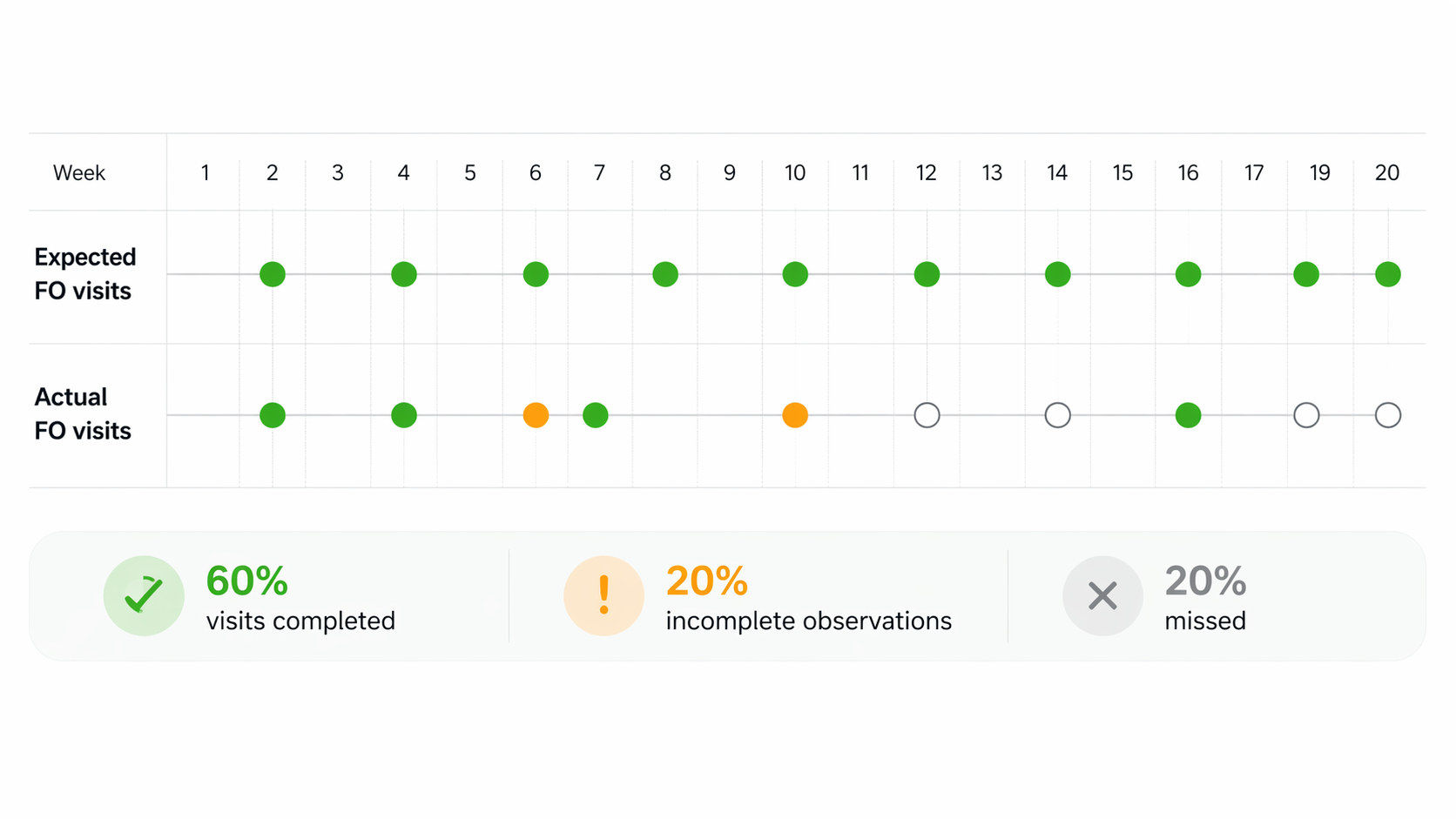
Field officers are the only team on the ground, and they’re covering hundreds of farmers across dozens of villages. Without a per-plot maturity signal, they’re guessing which plot to visit today. Some get missed. Not because of negligence — because of bandwidth.
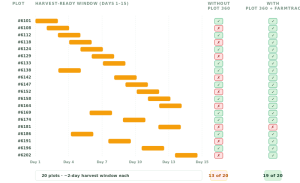
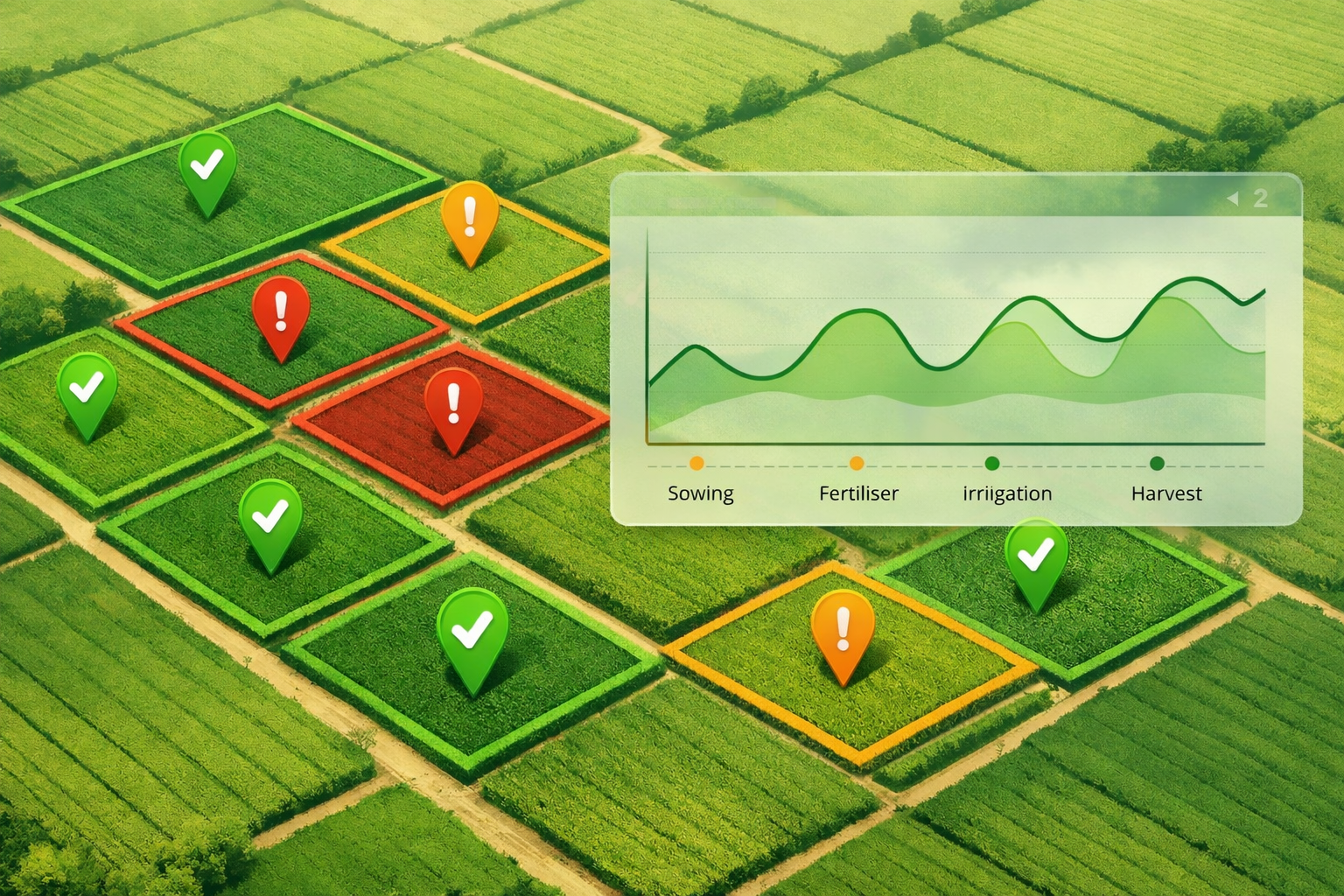
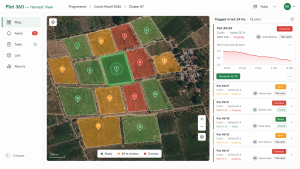
Plot 360 flags every plot when it hits harvest-readiness — daily, from satellite
Plot 360 doesn’t stop when the protocol window closes. In the harvest stage, the same architecture — geofenced boundary + daily NDVI / NDMI / NDWI + ML models trained on your crop and geography — detects maturity signals per plot, every 24 hours.
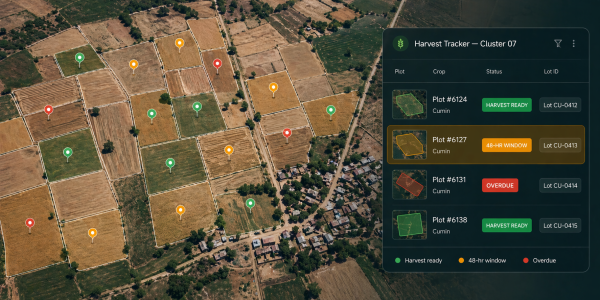
The moment a plot crosses the harvest-ready threshold, it’s flagged. The system knows which plots are ready today, which are 48 hours out, and which are overdue.
Farmtrac routes the right FO to the right plot, on an SLA clock
Detection alone isn’t enough. Farmtrac — the Data CRM layer — picks up every flagged plot and routes a task to the FO responsible, with a hard SLA.
- FO gets a task in the FO app + a WhatsApp nudge: “Plot #6124, cumin ready for harvest in 48 hrs. Visit today.”
- If the task isn’t closed within the SLA, it escalates to the cluster lead. If still open, to the program head — with the full plot history attached.
Program heads stop chasing status updates. The system surfaces only the plots that are actually stuck.
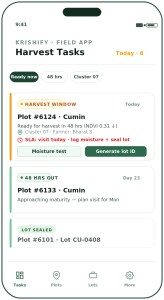
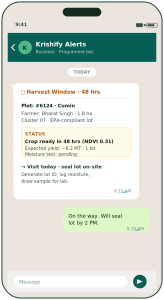
The FO app digitises the lot at source — moisture test, sealed lot ID, lab sample
When the FO reaches the plot, the post-harvest modules in the FO app close the loop:
- Moisture test logged on-site with the device reading.
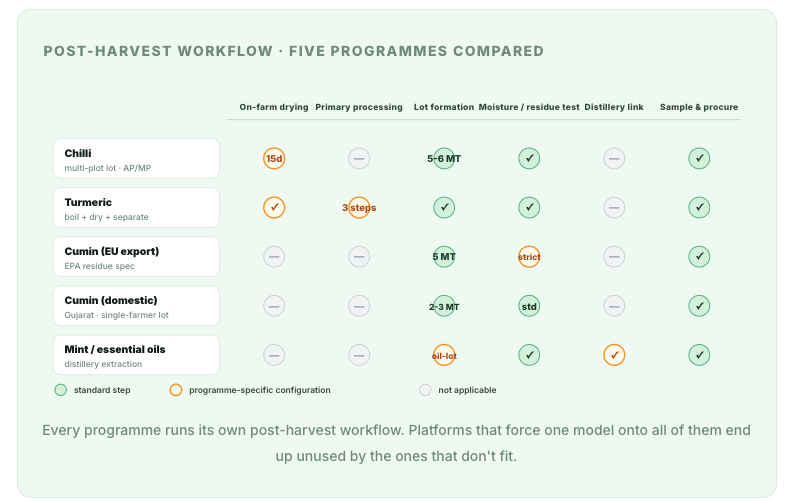
- Lot formed — typically 5–7 MT per lot for a crop like cumin — with farmer ID, plot ID, harvest date.
- Sealed lot ID generated and printed / tagged on the sack stack.
- Sample drawn and sent to lab with the same lot ID, for the spec test (EPA residue, in a cumin export programme).
- Procurement team sees the lot + lab result on Farmtrac and green-lights the pickup.
Every MT that moves now has a digital trail from plot to procurement — lot ID, test results, FO sign-off, timestamp. The farmer gets paid faster because the paperwork is already done.
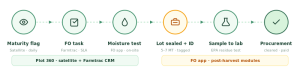
Example: an EPA-compliant cumin export programme, end-to-end
A grower programme exporting cumin to the EU runs on a strict residue spec. Previously, 25%+ of compliant harvest was being lost to local traders in the 10-day window — the FOs couldn’t get to every plot in time to seal the lot.
With Plot 360 flagging maturity daily, Farmtrac routing on SLA, and the FO app digitising the lot at source:
Not satellite monitoring — programme orchestration
Detecting a ready plot is a small part of the problem. The value is in closing the loop: detection → task → SLA → digitised lot → lab → procurement. All on the same system, running on the same plot ID, end to end.
Krishify’s Farmer Programme Management OS runs this orchestration today across programmes in grains, horticulture, spices, and sugarcane. If you’re losing supply in the harvest window, let’s talk.