
The problem: no two farmer programmes run the same workflow
Most food and sustainability companies run more than one farmer programme. Different programmes cover different crops, often across different geographies, and each one demands its own workflow. That’s where most platforms fall short.
The single most underrated constraint in agri platform adoption isn’t feature depth or satellite coverage. It’s configurability — and it shows up most visibly in post-harvest, where crop workflows diverge sharply.
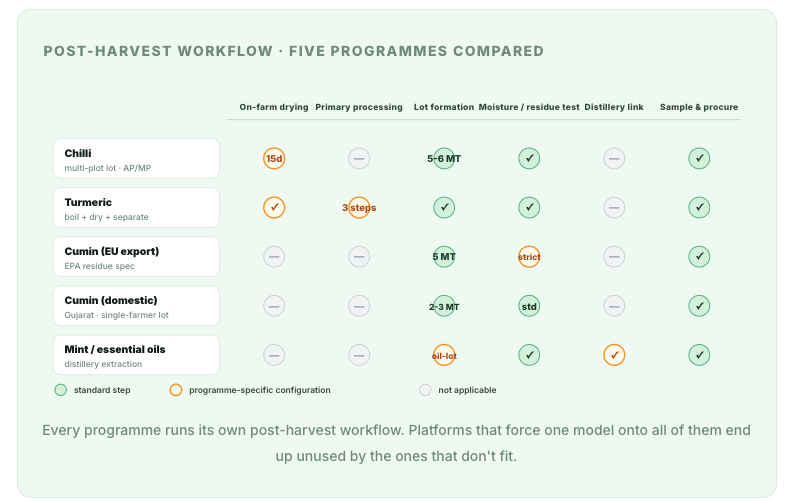
Chilli programmes: small per-farmer volumes and a 15-day drying phase most platforms ignore
A chilli farmer produces small volumes, so the programme has to aggregate produce from multiple plots into a 5–6 MT lot before testing begins. And after harvest, chillies are dried on-farm for about 15 days — a phase that materially affects quality and compliance (drying method, contamination risk, weather damage from rain or heat) but one that most platforms don’t capture at all.
Turmeric programmes: three primary processes before a lot can even be formed
Turmeric has three primary processes between harvest and lot formation — boiling, drying, and separation of fingers from bulbs. Only then does sample testing happen. A platform that jumps from “harvest” to “procurement” misses three critical events in between.
Cumin and coriander programmes: no primary processing, but strict moisture and residue controls
Cumin and coriander have no primary processing at the farmer end. The crop is harvested, held until moisture is in range, tested, then procured. But the lot-formation rule, moisture thresholds, and sampling approach vary sharply between, say, EPA-compliant cumin for EU export and the same crop in a domestic-grade programme.
Mint and other essential-oil crops: lots are formed at the distillery, after extraction
Mint and essential-oil crops break a basic assumption — the farmer’s produce isn’t the procurement unit. Biomass goes to a distillery, and the extracted oil is what gets tested and procured. The platform has to model the distillery, link distillation batches to source plots, and track oil yield per lot. That’s a different data structure, not just a different set of fields.
The same crop, in a different geography, often needs a different workflow too
Even within one crop, geography changes the workflow. A cumin programme in Gujarat may form single-farmer lots at 2–3 MT; the same company’s cumin programme in Rajasthan may aggregate across 3–4 farmers to hit 5 MT. A chilli programme in Andhra runs on different drying norms than one in Madhya Pradesh.
Beyond post-harvest: data capture, crop protocol, and sustainability metrics also vary by programme
The variation isn’t limited to post-harvest. Data capture differs — procurement programmes track plot and harvest data; sustainability programmes add water and input use; Scope 3 programmes layer in carbon. Crop protocols differ by season and buyer spec. Sustainability metrics differ by regulator, buyer, and internal ESG target. In practice, each programme inside the same company is its own software configuration.
How Krishify handles it: configurable modules, set up per programme, running inside the same application
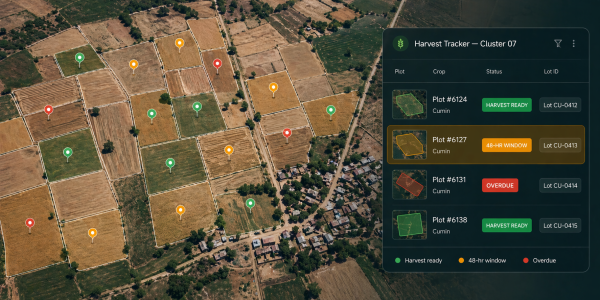
Krishify’s Farmer Programme Management OS is built as a library of configurable modules — plot registration, protocol, data capture, post-harvest workflow, lot management, sampling, procurement, sustainability tracking. Each programme is configured separately: chilli with multi-plot aggregation and on-farm drying; turmeric with boiling, drying, and separation steps; cumin for EU export with strict moisture and residue controls; mint with distillery-linked lot formation.
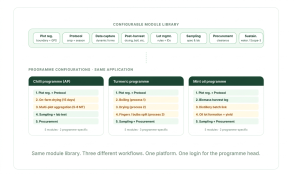
Same application. Same login. Same dashboard structure. A different workflow behind every programme.
Krishify’s Farmer Programme Management OS runs today across programmes in grains, spices, horticulture, essential oils, and sugarcane. If you’re running or scaling more than one farmer programme, let’s talk.